


More Information
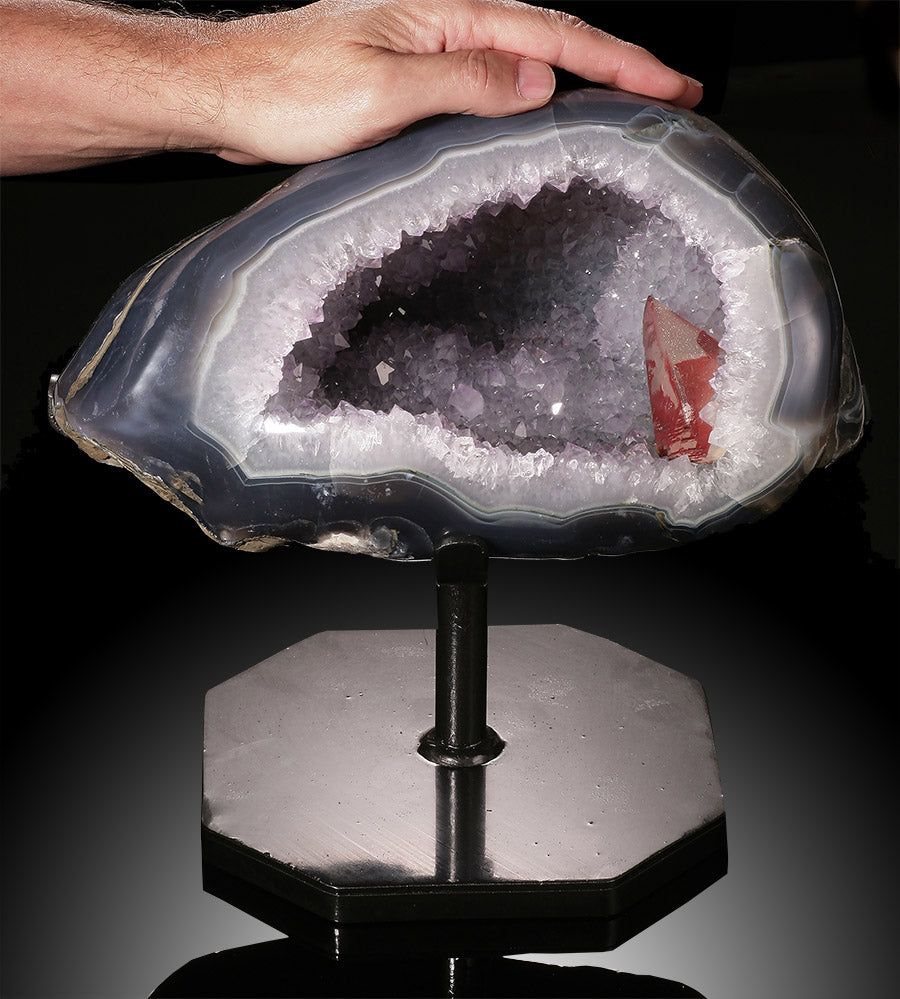
Brazilian Agates are found in the southern states in basalt formations from 4 to 40 feet deep and at elevations of about 2500 to 3500 feet above sea level. Agate is a variety of silica composed of alternating layers of various colored chert or quartz. Agates were named after the Acate River in Sicily where the stones were originally found. The most accepted theory as to how these Agates formed is that as lava cooled, gas and steam accumulated to form bubbles or cavities. For many eons, water that carried silica penetrated the copper and iron-bearing rock surrounding the cavities, filling them with irregular internal layers. Finally, the whole mass hardened, ending a 50 million-year-long process and leaving beautiful, interesting stones for collectors to find and enjoy.
Amethyst is a variety of quartz which owes its coloration to the presence of iron in the area of its formation. The word Amethyst is derived from ancient Greek meaning "intoxication". It was believed by both ancient Romans and Greeks, if they wore Amethyst or made their goblets of the material, it would help prevent them from becoming intoxicated. Amethyst has been used in jewelry making for centuries. Spectacular, priceless carvings dating to the ancient Egyptians are displayed in museums. Amethyst is found in many places around the world. However, the most beautiful Amethyst, displaying deep rich purple coloration, is normally found in the countries of Brazil and Uruguay. Amethyst is the birthstone for February.
Calcite is one of the most common minerals which grows in a wide variety of different shapes, colors and translucencies. The mineral itself actually belongs to a calcite group of "related carbonates" that are "isomorphous" with each other. All members of the group crystalize in triangular formations, have perfect rhombohedron cleavages, and in transparent rhombohedrons, display strong double refractions. Aragonite and Calcite are similar in chemical composition (polymorphs) but are structured differently, with Calcite forming triangular crystallization and Aragonite forming orthorhombic crystals (three axes planes, at unequal lengths, and all three axes 90 degrees to one another. Unique Calcite formations are created inside the caves where calcium rich water penetrates the cavern's limestone enclosure and slowly drips and flows on top of itself, allowing for the formation of unique stalactite and other globular formations to be created. In this slow process, other minerals can intermix with each other, adding to the interest and forming unusual specimens, such as the one displayed.
