


More Information
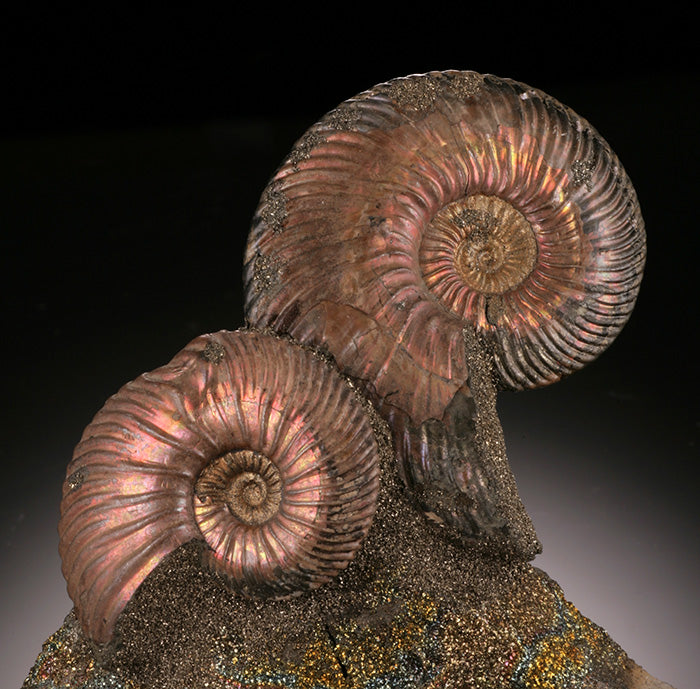
Ammonites are an extinct group of marine animals in the Cephalopoda class. They are invertebrates and are more closely related to coleoids (squids, octopus, and cuttlefish) than they were to the chambered nautilus, even though they looked much more similar to the later. The name Ammonite was derived from "ammonis cornua," translated to mean Horns of Ammon. Ammon was an Egyptian god that was typically depicted wearing ram horns, whose spiraled shape is similar to that of an Ammonite. Ammonites first appeared in the oceans during the Devonian Period, some 400 million years ago. They died out around 65.5 million years ago along with the dinosaurs.
Between 145 and 65 million years ago these extinct marine creatures, Cleoniceras cleon, flourished in a warm, shallow sea which covered much of the earth. As the shells of the creatures accumulated on the sea floor, they were buried by sediment and, over the ages, transformed into stone by physical and chemical processes. The chambers of the Ammonite acted as tiny geodes, allowing calcite to form crystals throughout.
A golden yellow to brown, widely occurring mineral sulfide, FeS2, Pyrite is used as an iron ore and to produce sulfur dioxide for sulfuric acid. It is also known as Fool's Gold because it resembles gold, even though it is harder (H. 5-6) and a paler yellow. Pyrite is often found in quartz veins, sometimes even with gold. Pyrite crystals are common; it may also occur as grains or in masses. It streaks a greenish black and when tarnished, may resemble chalcopyrite. If struck sharply against steel, pyrite gives off sparks. It is thought that early man carried pyrite to start fires that contributed to his survival. The name itself is derived from the Greek πυρίτης (puritēs), "of fire" or "in fire," from πύρ (pur), "fire.” Although Pyrite is fairly common, specimens such as this are highly collectable. Found only in the underground coal mines of Sparta, Illinois, are unique mineral specimens known as Pyrite Suns. These unusual Pyrite specimens are found imbedded in compacted slate, amongst coal deposits which formed some 300 million years ago. It is theorized that the development of these striated Pyrite specimens is due to the great amount of pressure exerted upon them, forcing them to spread out laterally, rather than developing in a more common cubic form.
